Altitude Effects on Ball Trajectories and Race Times in High-Elevation Venues
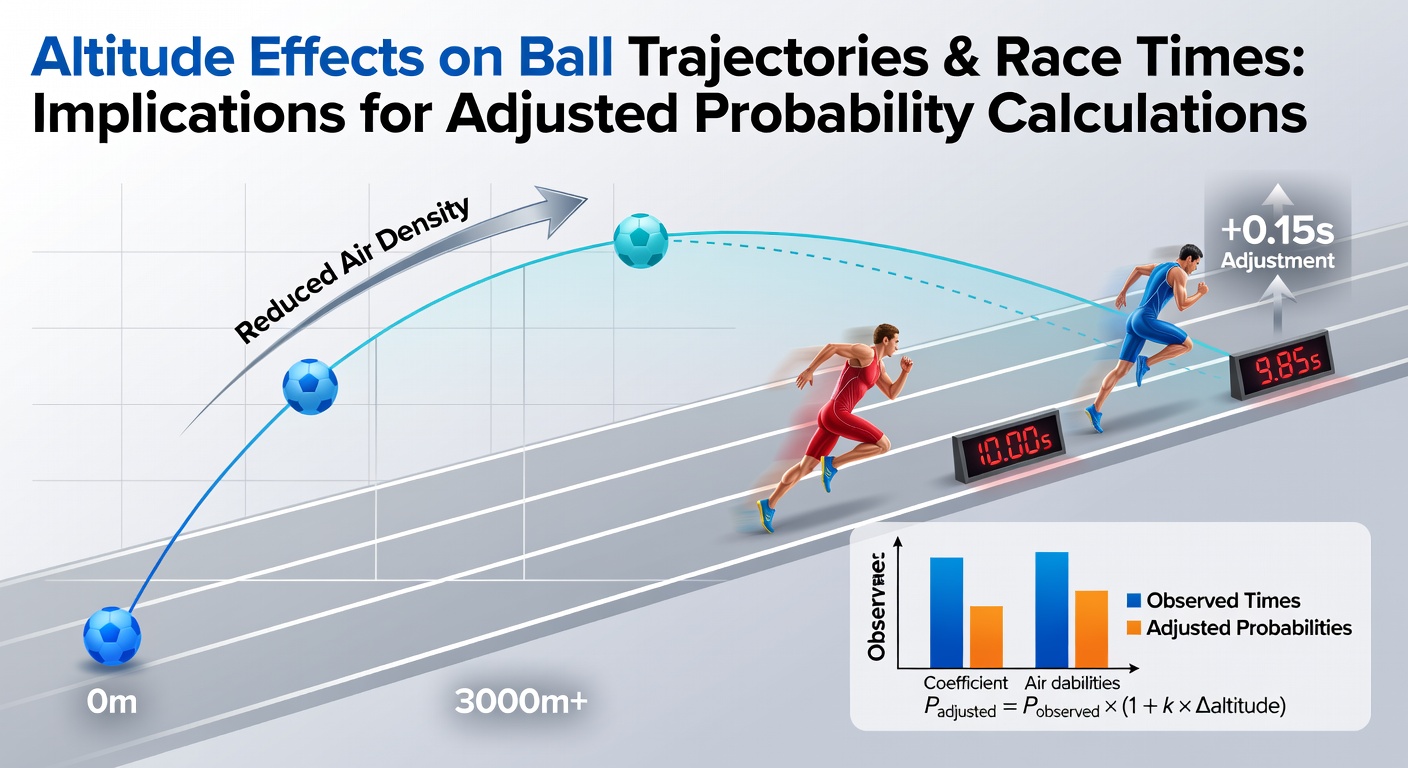
High-elevation venues create measurable changes in air density that alter how balls move through space and how athletes perform over timed distances, and these shifts require specific adjustments in probability models used for performance forecasting. Air pressure drops as elevation rises, which reduces drag forces on spherical objects while simultaneously limiting oxygen availability for human exertion. Researchers have documented these patterns across multiple sports and locations, including soccer matches in Mexico City at 2,240 meters and track events in Denver at 1,609 meters.
Physics of Ball Flight at Elevation
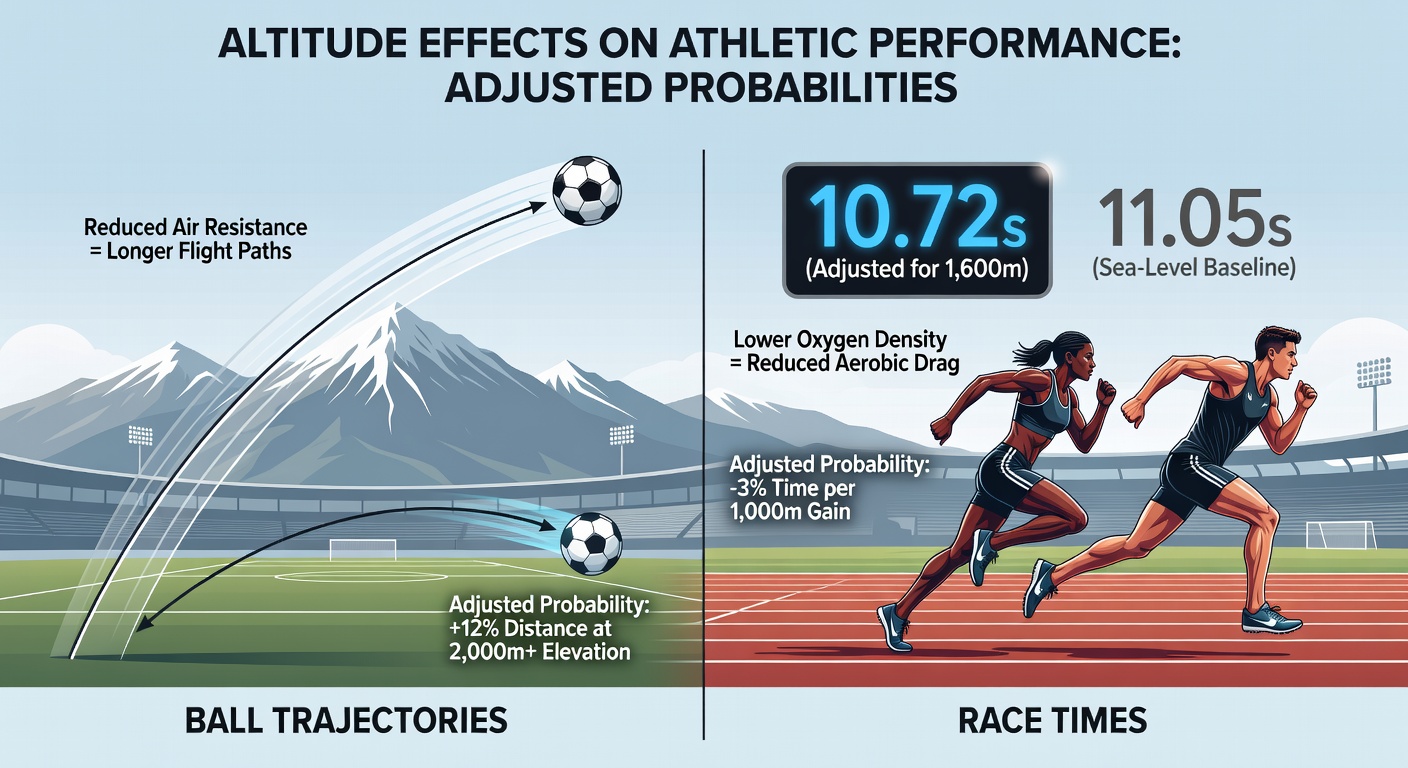
Reduced atmospheric density decreases resistance on balls during flight, allowing projectiles to maintain higher velocities over longer distances compared with sea-level conditions. In soccer, forward passes and shots exhibit flatter arcs and extended range because the Magnus effect interacts differently with thinner air, while tennis serves gain additional speed and bounce variations appear more pronounced on outdoor courts. Basketball trajectories show similar extensions in three-point attempts and long passes, with data from venues above 1,500 meters indicating average shot distances increase by 3 to 7 percent according to motion-capture studies. Observers note that spin rates remain consistent yet the resulting curve or dip diminishes, which affects defensive positioning calculations in real time.
Adjustments for Race Timing Metrics
Endurance events face opposing pressures because lower oxygen partial pressure reduces aerobic capacity even as reduced air resistance offers minor benefits to sprinters and hurdlers. Studies from the University of British Columbia have quantified how 5,000-meter times slow by 2 to 4 percent at 2,000 meters elevation when compared with equivalent sea-level efforts, whereas 100-meter dash performances improve marginally due to decreased drag. Horse racing data collected at tracks such as those in Johannesburg reveal comparable patterns, with sprint distances recording faster sectional times while longer routes show cumulative fatigue effects that extend overall durations. These differentials feed directly into probability models that recalibrate expected outcomes for each discipline.
Venue-Specific Data Patterns
Multiple high-altitude sites produce repeatable statistical signatures that analysts incorporate into forecasting tools. Denver's stadiums consistently demonstrate ball carry increases across American football and baseball, while Andean locations like Quito generate pronounced effects on soccer passing networks. Track meets scheduled for May 2026 in elevated regions will likely apply updated correction factors derived from recent physiological monitoring programs. Australian Institute of Sport reports highlight parallel findings in endurance cycling and running, where heart-rate thresholds shift upward and recovery intervals lengthen measurably above 1,800 meters.
Integration into Probability Calculations
Adjusted models apply elevation coefficients to baseline statistics before generating outcome probabilities, which prevents systematic overestimation or underestimation of scoring rates and finishing times. Ball-trajectory algorithms incorporate drag coefficients scaled by altitude while race-time projections layer oxygen-uptake reductions onto historical pace data. Organizations such as World Athletics maintain reference tables that convert performances across elevation bands, and these tables now feed automated systems used by statisticians preparing event previews. One study from Stellenbosch University in South Africa demonstrated that uncorrected models produced error rates exceeding 12 percent when applied to altitude-based competitions without modification.
Measurement Techniques and Recent Findings
Modern tracking systems combine barometric sensors with video analysis to capture real-time environmental variables during competitions, yielding datasets that refine existing correction formulas. Data collected through 2025 shows consistent elevation multipliers for different ball types, with soccer exhibiting the largest trajectory shifts and tennis displaying notable serve-speed gains. Race timing networks record both instantaneous velocity changes and cumulative oxygen debt effects, allowing granular segmentation of performances by race segment. These layered measurements support increasingly precise recalibrations that account for temperature and humidity interactions alongside pure altitude variables.
Conclusion
High-elevation effects on trajectories and times represent quantifiable physical phenomena that statistical frameworks must accommodate to maintain accuracy across venues. Continued collection of synchronized environmental and performance data enables ongoing refinement of adjustment protocols used in forecasting applications. Venues hosting major events in May 2026 will provide further test cases for validating these models under competitive conditions.